Total Pageviews

Wednesday, December 26, 2018

Winter in The Bowl Research Natural Area

Only a short jaunt from a busy trail in the Sandwich Range, White Mountain National Forest, lies a special primeval forest that holds rare secrets to New Hampshire's distant past, unbeknownst to the common passerby. Situated in a bowl-shaped glacial cirque, the saddle of Passaconway and Whiteface mountains forms its northern headwall offering centuries of protection from the disastrous hurricane of 1938, wildfire and generations loggers that took 99% of all forest in the east. What remains is a pocket of old northern hardwoods forest that appears as it had to early settlers and Native Americans. As a testament to its magic, and the dedication of the Wonalancet Outdoor Club, it became protected and named The Bowl Research Natural Area in 1913 - the very year Henry Ford developed the modern assembly line.

On a mild winter day, I strapped on my snowshoes and walked through a small village to Dicey Mills trail for over a mile until I reached the bowl. I walked to the west to find Wonalancet brook, then hiked north. It wasn't long before I encountered a towering grove of sugar maples across the brook. Large trees with tall, straight trunks and no low hanging limbs gave the first clue that I was entering a special place. The forest's energy changed from there on.


Not much further up the brook toward its headwaters, I came across a cathedral of gargantuan yellow birch, American beech and more sugar maple - some of which have been recorded to be over 400 years old. I've seen these species many times before in second-growth forests, but never like this. Here, they were spaced far apart with a small shrub understory of hobble-bush and striped maple.


The sugar maples are as tall as I have ever seen them. Their buttressed roots are meant to keep them from toppling over during storms. Their crowns are a tangle of gnarly branches with evident pruning from harsh winds.

The spacing between trees is reminiscent of a park, with a lot of open space in the understory and little open space in the crown. Downed trees were frequent, forming pits and mounds from upended root balls. 

Rocks of all shapes and sizes were strewn about all over to suggest that no agriculture had ever occurred. No stone walls, structures, litter, invasive species or obvious absence of rocks were anywhere to be found.

At some point, I stood still and listened to the melting snow drip from tall tree branches. I could hear the entire forest process the moisture to the bursting brook. I could smell the sweet scent of red spruce and feel the light winter breeze on my face. Through the leafless branches, I could see the surrounding mountain peaks in the distance.


Much like the ancient white pines I encountered in Elder's Grove in the Adirondacks, these trees also had bark that looked completely different than younger trees. Sugar maples were deeply furrowed with flaky bark, and yellow birch had scaly patterns in between papery bark. Large American beech were not nearly as smooth as younger trees.

Big trees are not the only sign of an old-growth forest. An abundance of wildlife and sign  was seen all throughout the bowl. I noticed sprinkles of cuttings from red spruce twigs. During winter, red squirrels eat cone seeds for nutrients and often times take the twig by accident.


Bobcat and bear tracks lined the brook, pileated woodpeckers took advantage of standing dead logs, and many trees had lines of holes made from yellow-bellied sapsuckers. Fungus were abundant on dead and dying trees including chaga, and lichens were on trees and rocks.


A student of forests, I've come to learn that all woodlots tell a unique story. Nearly all have distinct legacies of human disturbance.Though, few pockets of virgin forest like this area remain that, to a trained eye, tell a very different tale - one of wilderness, harmony and pure nature. Many forests have big trees but few are pristine and undisturbed. And although all old growth forests have common characteristics, not all habitat's are represented today and, in my experience, every patch looks, feels and functions differently. Without the dedication of the Wonalancet Outdoor Club, Forest Service and other conservationists, this gem would not be what it is today.

Monday, August 13, 2018

The Big Ditch - An American Pastime


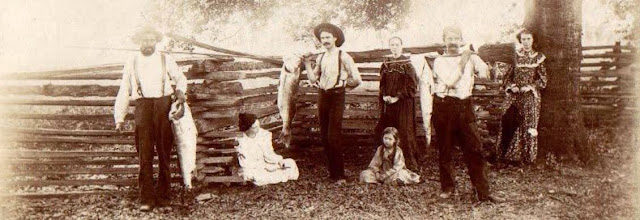
The idea of the Cape Cod canal was born nearly 500 years ago as Myles Standish of the Plimoth Colony dreamt of connecting the Manomet and Scusset Rivers – then full of coveted salt-run brook char - to expedite trade with local Wampanoag and Dutch to the north. After years of feasibility studies, the canal broke ground in 1909 and opened to traffic by 1914 providing easier trading, wartime safety, and consequently world-class fishing. This would’ve been around the time my great ancestor, Cristopher “Crit” Whittemore (pictured left), fished for striped bass. Here, he stands below a big pin oak likely along the Connecticut River during a herring run in the late 1800s.


This season, I made a point to learn from the infamously unforgiving canal. Locals joke that it holds more lost lures to its rocky substrate than fish. I put in time observing eddies during low tide, speaking to locals, watching birds, and tagging along with experienced friends. I saw generations of men clustered together whispering of what lure to use and how to fish the current conditions, ignoring passerbyers inquiring about their luck. Others woke up before dawn to walk the banks without a fishing rod in hand, merely in search of comradery.


I planned my ferry rides from Vineyard Haven to Woods Hole around the moon cycle. The new moon brings dark skies, bright stars and big tides. The breaking tides occur when the extreme low tide coincides near the break of day when the bite is strong. I napped by day and met my father and friends by midnight to claim our spot. After every story we told, more and more headlamps sprung up across the canal. The silence of anticipation was interrupted by the occasional barge and constant lead jigs raining down from across the ditch. I’ll never forget the sudden explosions of feeding fish on the surface as the sun crept up from the pitch pines. Grown men riding makeshift “canal bikes” creatively fitted with rod holders, tackle baskets and fish trailers passed back and forth chasing baitfish and their predators. Lines crossed and fistfights sprung up from time to time - the bite was on!

Within an hour's time, we caught big bass nearly every cast. Smaller fish were caught first before a lag in action. The big fish were next, expending less energy by cleaning up the disoriented tinker mackerel pushed up against the rocks below my feet - sometimes jumping onto the rocks to avoid the inevitable.


At some point, the adrenaline wears off and a breather is much needed. I look up with a sore back to find the banks lined with big fish - one per person - caught by those who claimed good spots.

     
Before long, men slowly trickled out from their spots dragging their keep, hoping to buy ice and make work on time. The streets are lined bumper to bumper with cars fastened with license plates of all different colors as the novices begin to show up.


What began as a quest to catch my first big canal fish this year turned into something more. The journey gave a glimpse into old-time America, and connected me with my past. I came across folks of infinite backgrounds, occupations and orientations bound together by our nation's oldest pastime. Dragging my fish up the steep bank staring off at the old Buzzards Bay Railroad Bridge built in 1910, I felt like I was passing through a speakeasy where I didn't hear a lick about religion, politics or money - just fish tales and what a great day it is to be alive. 'Til the next new moon!


Monday, April 9, 2018

The 1675 Grove: A Virgin White Pine Forest

Hidden, scattered vestiges of old-growth groves offer a living glimpse into pre-European America, largely untouched by the ax or plow. They survived the industrial revolution, the hurricane of 1938, the extinction of the passenger pigeon, the saw mill and all its men. Such areas are sparse and kept secrete and protected often only by a good family deed passed down generations. They make up less than 1% of their original area in the northeast, with only some forest types represented. For those that remain, they are diamonds in the ruff - true national treasures.

In the small town of Brighton, NY in Franklin County, a stand known as Elder's Grove or 1675 Grove (aptly named after the date of germination) is all that remains of a once expansive northern hardwood forest. Here, stately white pine (Pinus strobus) - one of the rarest old-growth tree species - tower above surrounding second-growth pole size forest like tropic emergent trees, making a nostalgic natural cathedral.


As a vegetation ecologist with a deep love for forests, I expect a virgin stand to consist of trees of all ages, or "uneven aged," but this tract is different. Eldner's Grove was studied and age-class distributions were created by forest ecologists who wanted to know its structure and composition. They found that the brunt of old-growth pine was approximately the same age, ~347 years old this year, hence the name 1675 Grove. This suggests that a natural disturbance likely occurred prior to germination such as a micro-burst like the one that devastated the region in 1995. What resulted is a grove consisting of a lot of monstrous trees fairly close together.


P. strobus shoots high above the shade tolerant red spruce (Picea pungens), with one tree over close to 160 feet tall and 13 feet in circumference, making it nearly the tallest tree in New York state! Large black cherry (Prunus serotina), sugar maple (Acer saccharum), yellow birch (Betula allegheniensis) are some of the more dominant associates. I was surprised to find little to no evidence of pine seedlings and saplings, hinting at the possibility of a changing forest.


The bark has a much different appearance than younger pines, even mature pines that are near 200 years old. Virgin pine has deeply furrowed bark with deep fissures and a disproportionately small crown in relation to its overall size, reminding me of giant sequoia trees. There is some crown shyness offering protection to limbs of this relatively soft-wood species. Expansive buttresses help anchor the advantageous root system into the sandy, well-drained soil they prefer. They are straight as an arrow with self pruned lower branches, and they are seldom plum to the ground, giving an appearance of a sort-of "drunken" permafrost forest.


As an ecologist, I also know that big trees are not all that make up a true virgin forest system. Old-growth stands characteristically have unkempt signs of natural disturbance such as tip-up mounds left by roots that create uneven ground, or large standing dead trees that died of old age. It's hard to believe a tree so massive could be supported by such underwhelming shallow roots.


In this forest, many trees snapped near the base, likely from the micro-blast of 1995 that downed thousands of acres of old-growth forest in the Adirondacks. Natural disturbances like this open up the canopy for regeneration of other trees, and the dead and decaying wood adds nutrients to the soil. 


Virgin forests in the northeast have all but disappeared, and many paint an accurate picture of what the Native Americans, first pioneers, and sawyers saw. They offer a pathway back in time, a spiritual connection, and a laboratory to scientists. But with humans aside, they are simply an intrinsic beauty to behold if not only for their rarity today. Some land is just meant to be preserved - like this tract - free from direct large-scale human disturbance. I hope that after reading this post, you will agree.

Saturday, October 28, 2017

Salter Brook Trout in Southeastern Massachusetts

Tucked away from the beaches, surf-casters, and tourists of southeastern Massachusetts lay hidden tidal creeks and streams filled with America's first sportsfish - the salt-run "salter" brook trout (technically a char). With a two-foot ice-fishing rod in hand, and a container of streamers, I climbed through thick brush to find the Quashnet River in Falmouth MA close to its drainage into Waquoit Bay. 


Only one species of brook trout (Salvelinus fontinalis) exists with two migratory populations: anadromous "salters" of the northeast, and potadromous "coasters" of the great lakes.  Salters migrate from the ocean to freshwater streams to reproduce. On Cape Cod, they migrate to saltwater in November after spawning, and overwinter there while striped bass and bluefish take vacation. They run again in April, and return to brackish or fresh water by mid-May. Brook trout can differ in appearance from stream to stream, but salters are typically heavy for their length and lighter in color, especially soon after returning from the ocean. 


Not all area streams are as healthy as the Quashnet. In the 1970s, Trout Unlimited began conserving habitat by placing rocks, stumps, native plantings and Christmas trees to add structure. Today ongoing sampling and GPS tracking helps monitor populations. With such success here and Red Brook in Plymouth, MA, other restorations are gaining steam. The nearby Lower Coonamessett River is slated for a wetland restoration this month to transform retired cranberry bogs into the sinuous, cold, and clean stream systems that harbored salters and other diadromous fish like the herring and American eel long before Europeans arrived.


Even without a bite, you will be hard-pressed not to find beauty and solitude in the hidden coastal streams of southeastern Massachusetts. During fall the red berries of winterberry (Ilex verticillata), hips of swamp rose (Rosa palustris), and the changing leaves of tamarack, oaks, maples, beech, and alder will keep you satisfied.


Some Massachusetts fisherman call salters the "fish of 1000 casts" and for good reason. I can attest that they are sparse, easily spooked, and mostly small in size. It was a treat to catch this 12" fish, but I dream of landing a large one this winter in the bay. If you make your way out to this hidden treasure, always make sure to respect the river, avoid disturbaing redds, and practice catch and release. 


Tuesday, July 4, 2017

Alpine Vegetation in the White Mountains

As 95-South was bumper-to-bumper for the fourth, Ashley and I had a care-free ride up north to the presidential range in the White Mountains National Forest. We spent the night in AMC's Joe Dodge Lodge for an easy exit onto Tuckerman's Ravine Trail to summit Mount Washington today. We knew the weather and visibility would be great, but nothing could've prepared us for such a colorful display of blooming alpine vegetation. The White Mountains are known to have over a dozen fine-scale alpine communities with hundreds of species. Leaving the Krummholz behind, we made our way up to Lion's Head lookout where the vegetation began to shift to low-growing alpine species.

It wasn't long before we found sporadic species in the cracks of granite and schist.
          
Purple mountain-heath (Phyllodoce caerulea) and pincushion plant (Diapensia lapponica).

 Greenland stitchwort (Minuartia groenlandica)

Tufted clubsedge (Trichoophorum cespitosum)

 A terrible picture of moss-plant (Harrimanella hypnoides)


Before arriving at the junction from Lion's Head trail to Mount Washington, we came across a lush alpine snowmelt meadow filled with diversity. 

Bog labrador tea (Ledum groenlandicum)

A diverse snowmelt meadow overlooking Tuckerman's Ravine filled with bunchberry (Cornus canadensis), Indian hellebore (Viratrum viride), and many more.

 Little bluet (Houstonia caerulea)

 
  Blue-eyed lily (Clintonia borealis) among long beech fern (Phegopteris connectilis).

 Alpine azalea (Loiseleuria procumbens)

 Mountain avens (Geum peckii)

     
Bigelow’s sedge (Carex bigelowii) and Highland rush (Juncus trifidus)


Bog laurel (Kalmia polifolia)


 Pin cherry (Prunus pensylvanica) is often associated with waste lands, but grows sporadically in high-quality alpine habitats where windthrow, rockslide, and avalanches have occured.

After hours of botanizing, we finally made it to the summit of Mount Washington. 

What a trip!


Saturday, April 29, 2017

Old-Growth Forests of the Smokies

Have you ever wondered what early pioneers saw when they first encountered the aboriginal temperate forests of eastern North America? How lucky were the Scots-Irish "Ulstermen" who found refuge within the very same mountain range they emigrated from during the 1700s - their dialects, whiskey, music, and might continue to flow through the southern Appalachians. How devastating it must've been for the thousands of Cherokee Indians who were forced away from such a spiritual masterpiece during the trail of tears, and the range of management practices that have since ravaged the landscape. The Great Smoky Mountains National Park (GSM) has undergone great change in the past 200 years, but remains the largest example of the biologically diverse Arcto-Tertiary geoflora in the world, home to large swaths of old-growth forest. 
This past weekend, I had the pleasure of taking a trip through time to explore some of the many old-growth forest patches in GSM. Of the 500,000 acres of land, roughly 100,000 are considered old-growth forest and, with only ~4% of original forest remaining in North America, GSM is undoubtedly a special place worth conserving for future generations. Although we have all come across large trees in the woods, there is something uniquely different about old-growth forests that few will ever witness.


Today, we understand the term "old-growth" to be synonymous with virgin forest, primary forest, primeval forest, and the like. Generally, they are characterized as attaining great age without significant disturbance, and thereby exhibits distinct ecological properties. Since archival records do not exist for some tracts of land at GSM, it is impossible to understand the exact legacy of land within the park. However, the tracts I visited were previously cored and aged to over 250 years old and signify some of the most pristine old-growth remnants of temperate deciduous forest in the country. Of the 28 main watersheds in GSM, only 6 contain old-growth patches - I visited patches in the Roaring Fork, Little Prong Little Pigeon River, and West Prong Little Pigeon River watersheds.

The park is home to five main community types, including the Spruce-Fir forest, which dominates the highest elevations >4,500 feet, and has the largest unbroken tract of old-growth red spruce forest in the world; Northern Hardwood forest, composed of many species typically found in New England; Hemlock forest, which has greatly been affected by the exotic insect, Hemlock Wooly Adelgid; Pine and Oak forest, existing in the driest areas; and the Cove Hardwood forests that not only exhibits the greatest species diversity, but make up over 80% of the park area. 

Besides the obvious difference in tree size upon entering old-growth patches, there were other attributes characteristic of undisturbed forests. For example, the structure seemed to be clearly stratified compared to younger forests, defined by a distinct separation between the ground, sapling, sub canopy, and canopy layers. I also noticed an increase in sheer diversity at all levels, and evenness in the tree canopy. In other words, there seemed to be far more species in older forests, with numerous co-dominant tree species in the canopy versus younger forests characterized by a dominance of one or two prolific species. Further, I didn't see one exotic plant species.


The GSM has over 10,000 documented species, and over 100 tree species within the park, and since the first published flora in 1964 by H. L. Hoffman, there have been over 1600 plant species found. In the Cove Hardwood forest patches I encountered, the canopy was mostly comprised of massive yellow buckeye (Aesculus flava), Carolina silverbell (Halesia carolinia), and tuliptree (Liriodendron tulipifera). Aside from composition, the trees are noticeably larger and taller with moss covered trunks. The soil is loose, moist, rich, and uneven due to pitfall gaps from fallen trees, with large fallen logs strewn about that act as nurse logs for numerous species. Although trees in the temperate forest often have taproots and a lack of prominent buttresses, as opposed to many tropical trees, I found buttressing on all old-growth trees I encountered, which help support their increased height and size. 

As I ate lunch below the tall canopy in the Cove Hardwoods forest, I took in the vibrant chorus of spring migrants such as the worm-eating warbler, warbling vireo, blue-headed vireo, cerulean warbler, and many more, while cautiously scanning the horizon after finding multiple instances of bear sign. In the old-growth Hemlock forests, black-throated green warblers kept me company, as I navigated through a labyrinth of rosebay rhododendron (Rhododendron maximum) at the bases of gigantic eastern hemlock (Tsuga canadensis) and sugar maple (Acer saccharum). Sadly, many of the hemlock trees have already succumbed to HWA, but some remain.

Having visited many other forests throughout the country, there is something intrinsically nostalgic to me about an undisturbed, old-growth woodland in eastern North America. They are well protected gems that are nearly extinct. Upon entering, I felt as if I was viewing the world through the eyes of an ancient denizen from a simpler time. Beneath the neon new-growth of this rich mesic forest did I find a deep respect not only for the ancient organisms that have persisted through luck and mercy, but also for the sad story of the natives, and the immigrant mountaineers that lived tough lives, or the calloused CCC men who helped build this country - this forest is a living history of North America. The cool, misty understory, vibrant bird songs, colorful spring ephemerals, and cultural connection is nearly indescribable, but eternally unforgettable. 

Even today, after almost a century, we would be wise to remember the words of Franklin D. Roosevelt when he designated the Great Smoky Mountains National Park in 1940: 

"We used up or destroyed much of our natural heritage just because that heritage was so bountiful. We slashed our forests, we used our soils, we encouraged floods, we overconcentrated our wealth, we disregarded our unemployed - all of this so greatly that we brought rather suddenly to face the fact that unless we gave thought to the lives of our children and grandchildren, they would no longer be able to live and to improve our American way of life."